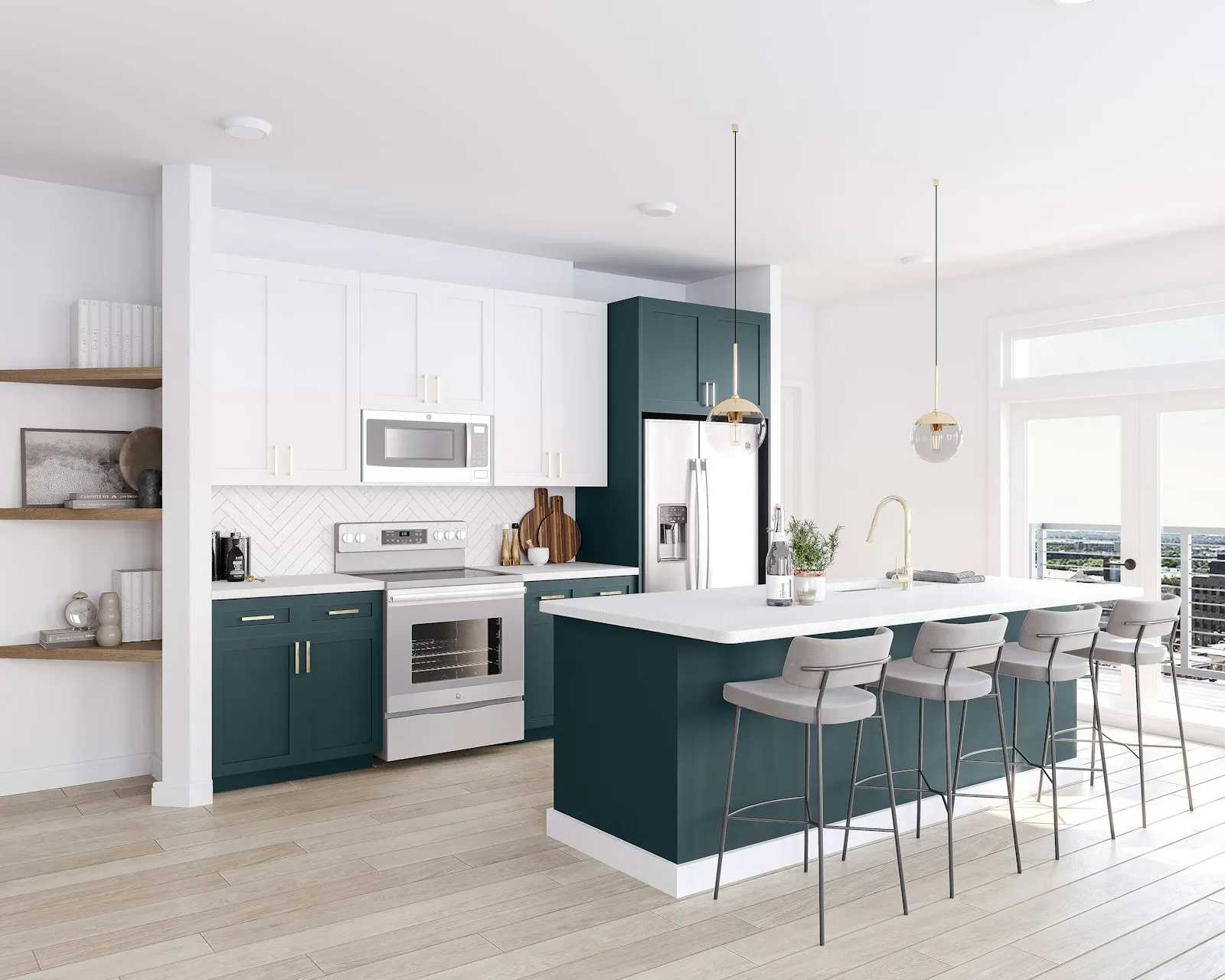
Ask three painters when to paint kitchen cabinets and you will get three calendars. Ask the wood and you get one answer, at least along the Front Range: paint when the doors are already dry. In Thornton that means the stretch from about October into March, and the reason has nothing to do with paint.
The problem is humidity, and ours is extreme
A raised-panel or shaker cabinet door is not one piece of wood. It is a frame with a center panel that floats in a groove. Cabinet makers build it that way on purpose. Solid wood swells when the air is humid and shrinks when the air is dry, and a panel that can slide in its groove does that without splitting.
Paint does not know about the groove. A finish applied across the joint between panel and frame bonds to both. When the panel later shrinks, the film gets stretched across a gap that did not exist when it was applied. The result is the hairline every cabinet forum has a thread about: a thin, straight crack tracing the inside edge of the frame. Two of the top-ranking articles on this subject are homeowners who painted oak doors in summer and found the lines in October.
How much the panel moves depends on how far indoor humidity swings across the year. That is where Colorado stands apart. We pulled a full year of daily weather for Thornton and worked out what each month’s outdoor air becomes once a furnace warms it to 70 degrees. In August the estimate lands near 48 percent relative humidity, right where wood is comfortable. By January it is about 12 percent. Humidifier guides call anything under 30 percent dry. The estimate sits under 20 percent for six months, November through April.
That swing, from the high 40s to the low teens, is what a summer-painted door has to survive. A door painted in November has already done most of its shrinking before the paint arrives. Whatever happens to it in January is a small step rather than a jump.
Why this hits the north metro harder than most places
Two local facts stack the odds. The first is altitude and climate: Thornton sits at about 5,200 feet in a semi-arid basin, and the mean dew point from November through February runs in the teens and low 20s. Very little moisture is in the air to begin with, and heating it makes the number worse. Humid-climate painters write whole articles about the opposite problem, paint that will not dry. That advice does not apply here.
The second is what our kitchens are made of. Nearly half the homes in Thornton were built in the 1970s, 80s and 90s, and Northglenn’s median house dates to 1974. That era means solid oak, usually with raised panels, and often original to the house. It is exactly the door type that moves the most. If you have honey oak doors and you are reading this in a Front Range zip code, the seasonal seam question is about your kitchen specifically.
So when, exactly?
Our read, for the doors that move:
Mid October to March is the sweet spot. The furnace is on, the wood has shrunk to its winter size, and the paint bonds to a door that is as small as it is going to get. When July comes and the panel swells, the joint closes tighter rather than pulling apart. A closed joint is not a visible defect. An open one is.
Late spring and summer are fine for the kitchen and hard on the seams. Nothing about the finish quality changes. The door simply has the whole winter shrink ahead of it. If you paint in June, expect the first hairlines around the panel edges in December or January, and know that they are cosmetic.
The shoulder months, April and September, sit between the two. Indoor air is in the 30s, the wood is mid-move, and the risk is moderate either way.
There is a quieter benefit to the cold months that has nothing to do with wood. Cabinet painting is a spring sport. Google search interest peaks in April and stays high through June, then falls by more than half by December. A painter’s calendar follows the same curve. The chart below is national and Colorado interest by month, and the tool after it lets you pick the month you have in mind.
What about the paint itself?
Every can lists an application range for temperature and humidity, and inside a heated home those numbers are met in any month. Cold-weather warnings about paint not curing are about garages and exteriors, not a kitchen at 70 degrees. The winter risk people describe online, tacky finishes and soft films, comes from painting in an unheated space. Indoors, the season is about the wood, not the chemistry.
Ventilation is the one practical winter difference. Opening windows in January is nobody’s favorite, and low-odor products exist for exactly this reason. Ask about it when you compare estimates.
If your doors are MDF, laminate or thermofoil
Most of this article is about solid wood. Newer shaker doors are often MDF, and MDF does not swell and shrink with humidity in any way you will see. Laminate and thermofoil do not either. For those kitchens the season question mostly disappears, and the right month is the one that fits your life. Our guide to which cabinets can be painted walks through how to tell what you have.
If you already have the hairlines
Take a breath. A seam line on a painted door is the wood moving, not the finish letting go. It does not spread the way chipping does, it often closes partway in summer, and it can be addressed at the seam when the wood is at its winter size. The cabinets that worry us are the ones chipping at handles and edges, which is an adhesion problem and a different conversation.
A humidity monitor costs around ten dollars and answers the question of how dry your house actually gets. If it reads in the teens all winter, a whole-home humidifier will do more for your cabinets, floors and trim than any paint choice.
The short version
Solid wood doors in the north metro: paint them when they are dry, roughly October through March, and pick a month when painters are not slammed. MDF and laminate: any month. Already have seam lines: they are cosmetic and seasonal, and winter is when to fix them. Whatever month you land on, the color decision is the part worth taking slow.